Anilox BCM and ink transfer volume
BCM is the ink-transfer volume of the anilox roll, and one of the variables that most affects your flexo results. Here is what it means, the reference ranges by application, and how to choose the right anilox.
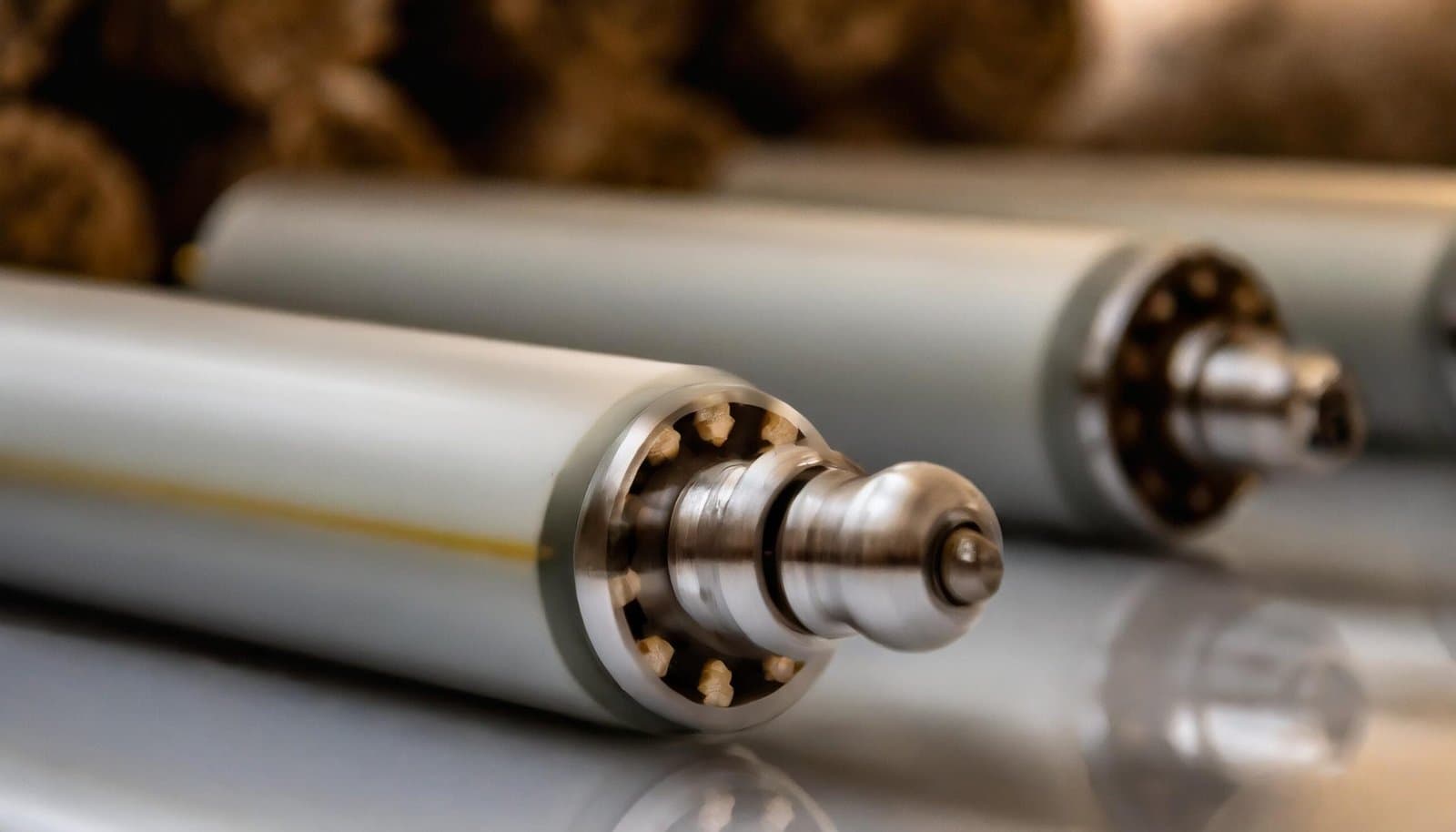
One of the variables with the biggest impact on your flexo work is the BCM of the anilox roll (the anilox ink-transfer volume).
How much ink the anilox delivers is a key factor in the printed result. That is why BCM in flexography is a variable you must control to optimize ink transfer during printing.
What is the anilox BCM?
It is a measure of the ink volume the anilox roll transfers to the photopolymer plate, expressed in billion cubic microns per square inch — BCM/in². For context, a cubic micron (μm³) is a unit of volume, and one billion cubic microns is 1,000,000,000 μm³.
Why BCM matters
This figure is critical when choosing the anilox: too high a volume can flood the print with ink, while too low a volume leaves it weak. The anilox transfer volume keeps the press process under control by determining how much ink reaches the plate.
Anilox rolls have microscopic cells that hold ink and release it to the photopolymer. The number of cells is set by the anilox line screen: the finer the line screen, the finer the ink metering. Different line screens offer different transfer volumes.
Anilox volume range chart
The following table shows the recommended range by application (industry reference, FTA standard):
| Application | Line screen (LPI) | Volume (BCM) |
|---|---|---|
| Fine process / high definition | 800 – 1200 | 1.0 – 3.2 |
| Vignettes and halftones | 360 – 600 | 2.8 – 4.7 |
| Line and type | 200 – 400 | 3.5 – 7.5 |
| Solids and heavy coverage | 180 – 330 | 4.0 – 8.0 |
| Opaque whites | 140 – 260 | 8.0 – 12.0 |
| Varnishes and coatings | 100 – 200 | 10.0 – 15.0 |
General industry reference ranges (FTA / Harper). The optimal volume depends on your ink, your substrate and your plate line screen; at iFlexo we validate the correct anilox for each job. 1 BCM = 1.55 cm³/m².
If your printed results are not what you expected — excessive dot gain, weak color, poor quality — the BCM of your anilox roll may be the cause. It is a variable to account for when setting up the press.
This helps you take corrective action and replace the anilox with one that has the right transfer capacity. Remember that it goes hand in hand with the plate's own line screen. Different jobs have different requirements based on the expected result, the substrate and the print line screen, so the anilox BCM should be an ally for quality results — or, if ignored, a recipe for trouble.
BCM conversion
One of the great challenges in printing is to print with the least ink possible, while still setting a standard for the anilox transfer volume so the print is neither weak nor overloaded with dot gain.
There is no single exact rule for picking the roll, but for the anilox line screen a common ratio is 1:6 — the anilox should be at least six times the plate line screen.
Example 1:
You have a 600 LPI anilox. The maximum plate line screen you can use is 100 lpi.
Example 2:
You want to print 150 LPI. You need at least a 930 LPI anilox.
It is worth clarifying that choosing the highest line screen is not always the best choice, and it is directly tied to the line screen of the flexo plate.
Converting BCM to cm³/m²
The volume unit of anilox rolls depends on where they are made. Rolls made in the United States express it in BCM; elsewhere you will find it in cm³/m². Converting between the two is simple.
BCM conversion:
To convert from BCM to cm³/m², multiply by 1.55.
2.4 BCM × 1.55 = 3.72 cm³/m²
To convert from cm³/m² to BCM, divide by 1.55.
3.72 cm³/m² ÷ 1.55 = 2.4 BCM
Remember that every anilox roll should be verified before replacement; the data sheet includes values that help you keep tighter control of the roll's BCM for the right choice.